Temperature22 – 30 °C
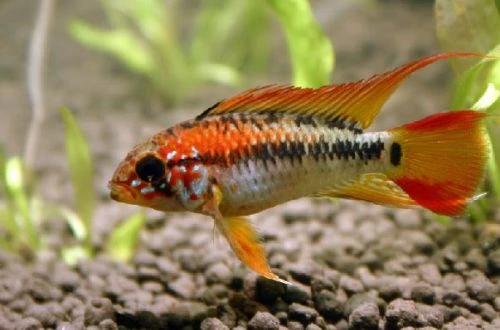
Apistogramma viejita, also known as the Fire-tailed Apistogramma, belongs to the Cichlidae family. This fish attracts attention with its bright coloration and calm temperament, allowing it to coexist well with many other species. Provided with suitable conditions, its keeping is not particularly difficult.
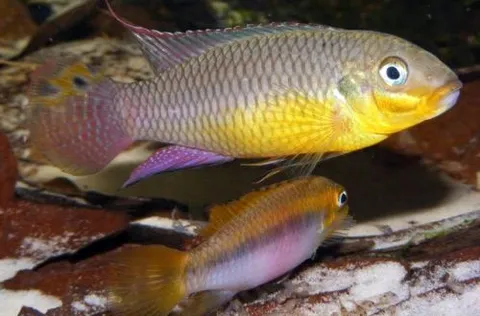
Adult males reach approximately 7 cm in length, while females are slightly smaller, not exceeding 6 cm. In terms of body pattern and coloration, this species resembles the closely related Apistogramma macmasteri, and is therefore often sold under that name. Males display a reddish coloration with distinct black markings running along the lateral line and a prominent spot on the caudal fin. Females, on the other hand, are less vibrant; their bodies are predominantly gray with yellow markings.
Its natural habitat is South America, specifically the territory of modern-day Colombia. It is found in the Meta River basin (Rio Meta), which flows through a lowland area. This river is characterized by a slow, calm current, numerous sandbanks, and an abundance of islands along its course. The water here is usually turbid and well-heated.
This is a peaceful and calm fish, perfectly compatible with other species of similar size and temperament, ideally suited for a community tank with Tetras. Intraspecific relations among males are based on dominance within a certain territory. It is recommended to keep them in a harem setup: one male should be accompanied by several females.
For a small group of these fish, the optimal aquarium volume starts from 60 liters. When setting up the tank, it is recommended to use a sandy substrate, dense thickets of aquatic plants, and create shelters using driftwood or other decorative elements. The most important aspect of keeping Fire-tailed Apistogrammas is maintaining stable water parameters and preventing the accumulation of harmful substances, such as nitrogen cycle products. This can be achieved through regular cleaning of organic waste from the aquarium, weekly water changes of 15–20% of the volume with fresh water, and the installation of an effective filtration system. When choosing a filter, it should be noted that it must not create excessive current, as this is undesirable for these fish; therefore, it is important to carefully consider the model and its placement.
The diet should primarily consist of live or frozen foods, such as daphnia, artemia, and bloodworms. Dry foods can serve as an additional source of vitamins and trace elements, but should be used as a supplement.
Breeding this species is possible, but requires certain skills and the creation of specific conditions. To increase fry survival, it is advisable to conduct spawning in a separate tank, which is set up similarly to the main aquarium. The water parameters should be very soft (dGH) and acidic (pH). The female lays up to 100 eggs in a small depression or pit on the bottom. After fertilization, both the male and female guard the clutch together. Parental care extends to the offspring until the fry reach a sufficiently large size. The young can be successfully fed with specialized micro-foods or artemia nauplii.
The main cause of most diseases in these fish is unsuitable keeping conditions and poor-quality nutrition. If initial symptoms are observed, it is first necessary to check water parameters and the concentration of dangerous substances such as ammonia, nitrites, and nitrates. If the indicators deviate from the norm, they should be brought back into order, and only then should treatment begin.
When purchasing, choose active fish with clean fins and no visible damage or sores on their bodies. Avoid individuals that appear emaciated, stay at the water surface, or show signs of apathy. In the store, it is important to assess the keeping conditions: the water should be clear, and tank mates should be peaceful, as stress from aggressive fish in shared systems negatively affects the apistogrammas' immune system. It is recommended to acquire a group of one male and several females to form a natural social structure.
The essentials: size, tank volume, water parameters and care
An adult reaches 6–7 cm in length. Plan the tank around the maximum size: the fish quickly outgrows a cramped setup.
The recommended volume is 60 L. A smaller tank speeds up nitrate build-up and raises stress levels.
Temperature 22–30 °C, pH 5.5–7.5, hardness 1–12 dGH. Stability matters more than exact values: sudden swings are harder on the fish than a small deviation from the ideal.
Around 3 years when kept properly. Lifespan depends directly on tank volume, water quality and a varied diet.
Temperament: peaceful (regular). Keep this in mind when choosing tank mates.
Recommended setup: harem (1 male and several females). Ignoring this is a common cause of stress and disease.
Diet type: meat / protein (live, frozen, fresh). Feed small portions that are finished within a couple of minutes — overfeeding does more harm than underfeeding.
The scientific name of the species is Apistogramma viejita, family Cichlids (Cichlidae).
The water suits 198 of 208 plants in the catalogue — the easiest ones are shown first.
Afzelius's AnubiasAnacharisAnubiasBrazilian PennywortDwarf CloverDwarf CloverDwarf HygrophilaDwarf SagittariaDwarf ValGuppy GrassHornwortJava FernJava MossMoneywortMud SwordNair's LagenandraNarrow Leaf AnacharisNarrow-leaf CloverStringy MossSüsswassertangTaiwan MossTape GrassTemple PlantUssuri Watermilfoil
Matched by family, categories and overlapping keeping conditions
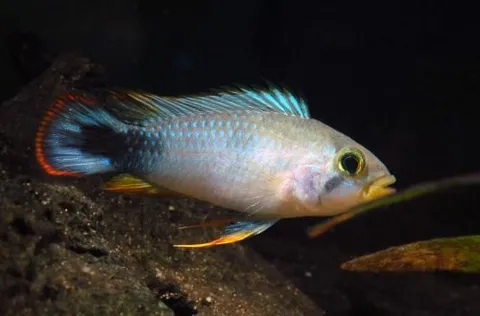
Apistogramma panduro
Apistogramma panduro, also known as the Azure or Blue Cichlid, belongs to the family Cichlidae. This South American cichlid is considered relatively undemanding in care and is well compatible with other freshwater…
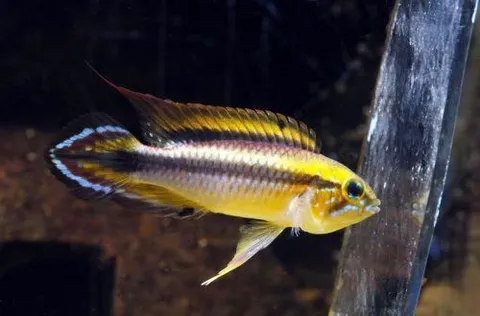
Apistogramma agassizii
Agassiz's Dwarf Cichlid, also known as Apistogramma agassizii, belongs to the family Cichlidae. This attractive fish is popular and comes in many selective breeding forms, which differ mainly in coloration. The species…
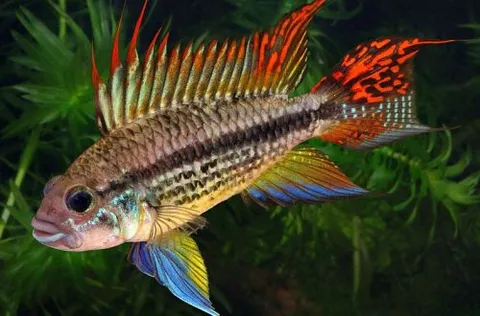
Apistogramma cacatuoides
The Cockatoo Dwarf Cichlid, also known as the Cockatoo Cichlid (Apistogramma cacatuoides), is a member of the Cichlidae family. This fish is one of the most striking representatives of South American cichlids and can…
Pelvicachromis taeniatus
A representative of the Cichlidae family, Kribensis taeniatus, also known by its scientific name Pelvicachromis taeniatus, is an attractive and rather undemanding fish. This fish readily coexists with many other…