Temperature24 – 30 °C
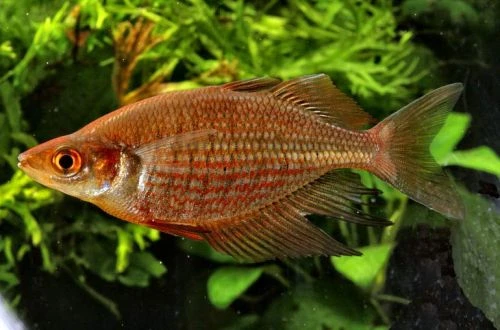
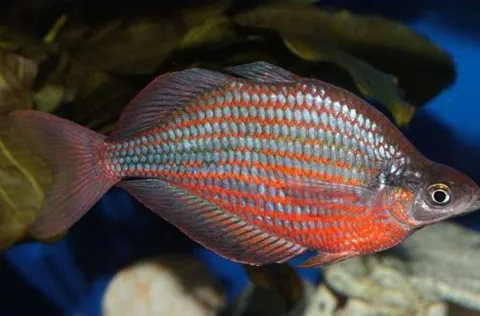
The Sepik Rainbowfish, also known as Glossolepis multisquamata, belongs to the family Melanotaeniidae. This fish gets its name from its original discovery location — the Sepik River on the northeastern coast of Papua New Guinea. It is an active, brightly colored, and peaceful fish, suitable even for beginner aquarists due to its unpretentiousness.
Adults grow up to 12 cm in length. Their body is characterized by a high but flattened shape, with a distinctly arched back and a pointed head. The coloration can vary significantly, from olive-green to silvery hues, with the lower part of the body often having a predominance of red or orange tones.
This species is endemic to the island of New Guinea and lives on the swampy floodplains of the northern rivers — the Sepik, Ramu and Mamberamo — so it occurs both in Papua New Guinea and in the Indonesian part of the island. These fish inhabit various bodies of water: rivers, lakes, and swamps. Unlike many other rainbowfish, they prefer well-lit areas with abundant aquatic vegetation and slightly acidic water.
These fish feel comfortable in the company of their own kind, so it is recommended to keep them in groups of 6–8 individuals. During spawning, males actively pursue females, so it is desirable to have more females. Males may also exhibit territorial behavior; in a small aquarium, it is advisable to keep no more than one male. They generally coexist well with other fish species of comparable size.
For a group of 5–6 fish, an aquarium of at least 150–200 liters is required. Since these fish are very active and prone to jumping, it is important to provide ample swimming space, and a lid will prevent them from accidentally leaving the water. Usually, floating plants serve as a natural barrier, but in this case, it is better to avoid them to prevent excessive shading, as Sepik Rainbowfish appreciate high light levels. The fish spend most of their time in the middle and upper water layers, so the decoration of the lower tier is not critical. The main attention in keeping them should be paid to water parameters. It is extremely important to maintain soft, slightly acidic water and prevent the accumulation of organic waste – such as food remnants or excrement – which can lead to a dangerous increase in the concentration of nitrogen cycle products. Regular maintenance of the aquarium and its equipment is mandatory. In particular, weekly water changes of 20–30% of the volume with fresh water are necessary with a powerful filtration system. In the absence of filtration, the volume of replaced water increases to 50%. The newly added water must match the existing pH and dGH values.
The basis of their daily diet should be protein-rich foods. The best choice will be a combination of live, frozen, and freeze-dried foods. These fish feed in the upper and middle layers of the water column.
Under favorable conditions, these fish spawn regularly. They lay their eggs among dense vegetation, and special artificial spawning mops can also be used. Spawning is protracted, as rainbowfish lay eggs in batches over several days. Consequently, the fry also appear gradually. Their parental instincts are poorly developed, and although the fish rarely eat their offspring, the clutch may be lost. Fry should be fed specialized foods, Artemia nauplii, or finely crushed dry flakes.
The risk of diseases significantly increases if environmental conditions do not meet requirements, fish receive poor-quality food, or are stressed by tank mates. Rainbowfish are particularly susceptible to skin diseases, including parasitic infestations and bacterial infections.
When purchasing, choose active and mobile individuals that show interest in food and display the species' naturally bright coloration. Avoid specimens with visible scale damage, film on the body, signs of emaciation, or unnaturally clamped fins. Since fish are prone to stress during transportation, it is important to ensure they do not show signs of timidity, manifested by a constant desire to hide in the corner of the aquarium.
The essentials: size, tank volume, water parameters and care
An adult reaches 12 cm in length. Plan the tank around the maximum size: the fish quickly outgrows a cramped setup.
The recommended volume is 150 L. A smaller tank speeds up nitrate build-up and raises stress levels.
Temperature 24–30 °C, pH 4.8–6.8, hardness 2–6 dGH. Stability matters more than exact values: sudden swings are harder on the fish than a small deviation from the ideal.
Around 8 years when kept properly. Lifespan depends directly on tank volume, water quality and a varied diet.
Temperament: peaceful (regular). Keep this in mind when choosing tank mates.
Recommended setup: medium group (6–8 individuals). Ignoring this is a common cause of stress and disease.
Diet type: any (universal). Feed small portions that are finished within a couple of minutes — overfeeding does more harm than underfeeding.
The scientific name of the species is Glossolepis multisquamata, family Rainbowfishes (Melanotaeniidae). It also appears in the literature as: Melanotaenia multisquamata.
The water suits 196 of 208 plants in the catalogue — the easiest ones are shown first.
Afzelius's AnubiasAnacharisAnubiasBrazilian PennywortDwarf CloverDwarf CloverDwarf HygrophilaDwarf SagittariaDwarf ValGuppy GrassHornwortJava FernJava MossMoneywortMud SwordNair's LagenandraNarrow Leaf AnacharisNarrow-leaf CloverStringy MossSüsswassertangTaiwan MossTape GrassTemple PlantUssuri Watermilfoil
Matched by family, categories and overlapping keeping conditions
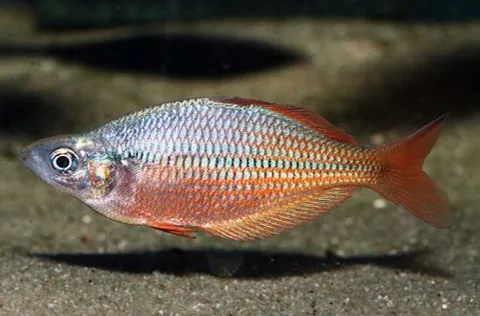
Melanotaenia splendida rubrostriata
The Red-striped Rainbowfish (scientific name Melanotaenia splendida rubrostriata), also known as the Red-banded Rainbowfish, belongs to the family Melanotaeniidae. This species can be an excellent choice even for…
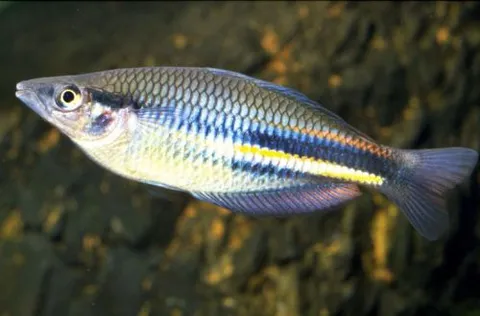
Melanotaenia affinis
The Northern Melanotaenia, widely known as the New Guinea Rainbowfish, belongs to the family Melanotaeniidae and has the scientific name Melanotaenia affinis. These beautiful fish are peaceful and undemanding, allowing…
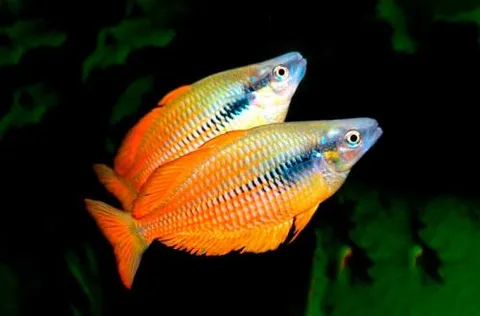
Melanotaenia angfa
Melanotaenia angfa, or Angfa Rainbowfish, is a member of the family Melanotaeniidae. The natural habitat of this species is limited to two tributaries of the Yakati River, located on the isthmus of the Cenderawasih…
Glossolepis dorityi
The fish, scientifically known as Glossolepis dorityi, or Dority's Rainbowfish, is a member of the family Melanotaeniidae. This species was first discovered by the renowned German researcher Heiko Bleher in 1999, but he…