Temperature22 – 27 °C
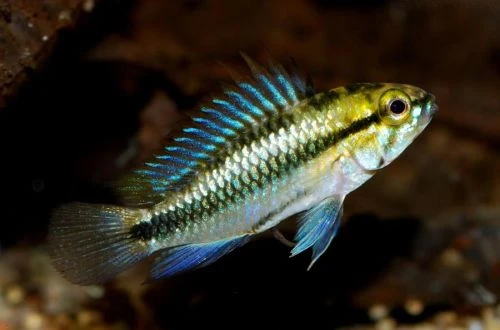
The Three-striped Apistogramma, or Apistogramma trifasciata by its scientific name, belongs to the Cichlidae family. These fish are suitable for experienced aquarists, as they are quite undemanding, breed easily, and coexist peacefully with other fish species, including fauna from other continents.
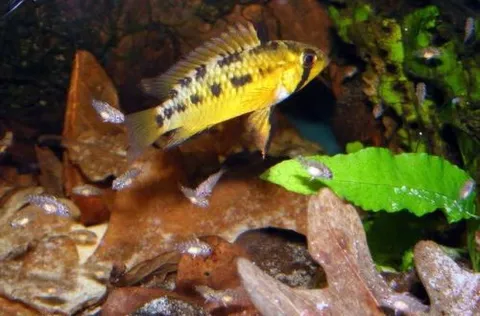
Males of this species reach a length of up to 5 cm, their coloration is silvery with noticeable blue hues, and their head is yellow. Females are significantly smaller, growing to about 4 cm, and are distinguished by their yellow coloration with a white belly. A distinctive feature of their pattern is three dark stripes: one runs along the edge of the back, the second extends along the middle of the body, and the third is located in the lower part of the belly and covers the anal fin. Slight differences may be observed between fish from different regions of origin. Therefore, in professional pet stores, an index is often added to the name, indicating the specific natural habitat. For example, indices A205 or A206 may indicate that the Apistogrammas originate from the Guaporé river system, located near the border with Argentina.
Its homeland is South America, specifically Paraguay and the southern part of Brazil. This species is found in the Paraguay River basin, as well as in the Guaporé River and the middle part of the Paraná. The Three-striped Apistogramma primarily inhabits small channels and streams hidden under the shady canopy of the tropical forest. Such places are characterized by a large number of snags, and the bottom is often covered with fallen tree leaves.
Males show intolerance towards each other, which becomes especially acute during the spawning period. In small aquariums, it is recommended to keep one male with several females. In more spacious aquariums, several males can be kept together. Otherwise, it is a peaceful fish, capable of coexisting with other non-aggressive species of similar size.
For a group consisting of 2–3 fish, an aquarium of at least 40 liters is considered optimal. The decor can be arbitrary, but the Three-striped Apistogramma will look most harmonious in an environment that recreates its natural biotope. A sandy substrate and several snags are well-suited for this. If breeding is planned, it is advisable to arrange shelters where the fish can lay eggs. For example, an overturned ceramic pot or a piece of PVC pipe can be used. The presence of aquatic plants is not mandatory, but shade-loving varieties can be planted if desired. Experienced aquarists often place leaves of some trees on the bottom, which not only adds naturalness to the decor but also helps create water chemistry close to natural conditions. During decomposition, the leaves release tannins, staining the water a brownish hue. For this, the aquarium is equipped with all necessary equipment, and regular maintenance is carried out. It is important to regularly change a portion of the water weekly, monitor ammonia, nitrite, and nitrate levels, remove organic waste (such as excrement and food residues), and keep the equipment in good working order.
This is an omnivorous species that readily consumes most common foods in a home aquarium. Their diet can include dry flakes, pellets, as well as live or frozen brine shrimp, daphnia, and bloodworms.
During the breeding season, the male occupies a specific area at the bottom of the aquarium. If other males are present in the aquarium, fierce territorial conflicts may arise between them. Females choose the most suitable male, in their opinion, and accept his courtship, after which they lay eggs in some shelter – this can be cracks or voids in the decorations. In general, males usually do not participate in caring for the offspring and continue to court available females.
The main cause of diseases often lies in the keeping conditions: if they go beyond acceptable limits, immunity decreases, making the fish vulnerable to various infections inevitably present in the environment. At the first suspicion of illness, it is important first of all to check the water parameters and ensure there are no dangerous concentrations of nitrogen cycle products. Often, restoring normal, suitable conditions promotes recovery. However, in some cases, medication may be required.
When choosing a Three-striped Apistogramma, pay attention to the fish's overall activity: healthy individuals should show curiosity, swim actively, and react to a person's approach. Avoid specimens with signs of emaciation, sunken bellies, fin damage, or whitish spots on the body, which may indicate infections. It is important to assess the fish's behavior in the store: if it constantly hides, appears apathetic, or makes convulsive movements, it is better to refrain from purchasing. — Check the cleanliness of the skin and the absence of unnatural growths or ulcers. — Pay attention to breathing: it should be even, without frequent gasping for air at the surface. — Prefer individuals with bright, clearly defined coloration, appropriate for their sex and age, as paleness is often a sign of stress or poor health.
The essentials: size, tank volume, water parameters and care
An adult reaches 4–5 cm in length. Plan the tank around the maximum size: the fish quickly outgrows a cramped setup.
The recommended volume is 40 L. A smaller tank speeds up nitrate build-up and raises stress levels.
Temperature 22–27 °C, pH 5–7, hardness 0–10 dGH. Stability matters more than exact values: sudden swings are harder on the fish than a small deviation from the ideal.
Around 3 years when kept properly. Lifespan depends directly on tank volume, water quality and a varied diet.
Temperament: semi-peaceful (including aggression during spawning / intraspecific conflicts). Keep this in mind when choosing tank mates.
Recommended setup: harem (1 male and several females). Ignoring this is a common cause of stress and disease.
Diet type: any (universal). Feed small portions that are finished within a couple of minutes — overfeeding does more harm than underfeeding.
The scientific name of the species is Apistogramma trifasciata, family Cichlids (Cichlidae). It also appears in the literature as: Apistogramma maciliense, Apistogramma maciliensis, Apistogramma trifasciatum.
The water suits 198 of 208 plants in the catalogue — the easiest ones are shown first.
Afzelius's AnubiasAnacharisAnubiasBrazilian PennywortDwarf CloverDwarf CloverDwarf HygrophilaDwarf SagittariaDwarf ValGuppy GrassHornwortJava FernJava MossMoneywortMud SwordNair's LagenandraNarrow Leaf AnacharisNarrow-leaf CloverStringy MossSüsswassertangTaiwan MossTape GrassTemple PlantUssuri Watermilfoil
Matched by family, categories and overlapping keeping conditions
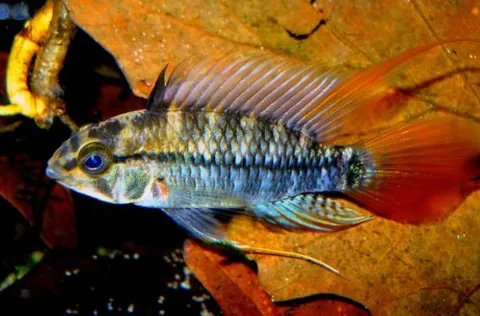
Apistogramma eunotus
The High-fin Apistogramma (Apistogramma eunotus), a representative of the Cichlidae family, is one of the popular South American cichlids. Its keeping does not present particular difficulties for experienced aquarists,…
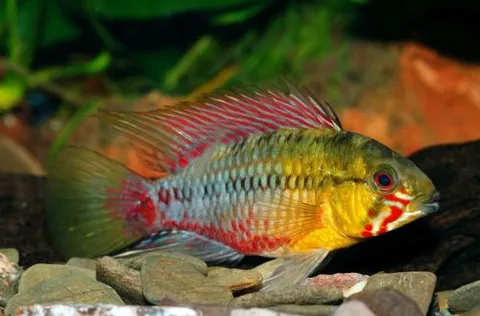
Apistogramma hongsloi
Apistogramma hongsloi, known as Hongslo's Dwarf Cichlid, belongs to the Cichlidae family. It is a beautiful and vibrant fish, relatively easy to care for, but characterized by complex intraspecific relationships.…
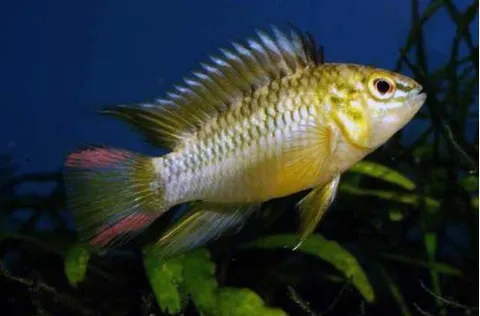
Apistogramma hoignei
Apistogramma hoignei, known as Hongslo's Dwarf Cichlid, belongs to the Cichlidae family. This is an energetic fish, especially the males, which are distinguished by their bright coloration. Experienced aquarists usually…
Apistogramma macmasteri
Apistogramma macmasteri, also known as the Red-tailed Dwarf Cichlid (scientific name Apistogramma macmasteri), belongs to the family Cichlidae. This fish attracts attention with its beauty, but its temperament can be…